Personalization guides
How to Turn Birthday Photos into a Personal Story
Arrange birthday photos into a story with a beginning, familiar moments and a thoughtful ending. Includes a fictional five-picture sequence and caption examples.
- By WishVerse
- Updated
- 5 min read
Give the photo story one idea
A birthday photo story works when the pictures connect, not just when they are placed in date order. Start with a sentence that describes the collection: “The small adventures we keep finding,” “A year of making a home” or “The ways you bring people together.” That sentence gives you a way to choose what belongs.
Keep the recipient at the center. The collection can include you, but it should help them feel seen rather than become a record of everything you arranged. You do not need to cover every stage of a relationship. One small theme can hold three to six pictures comfortably, and a message-only surprise remains a good option if pictures do not fit.
Use a beginning, a middle and a birthday ending
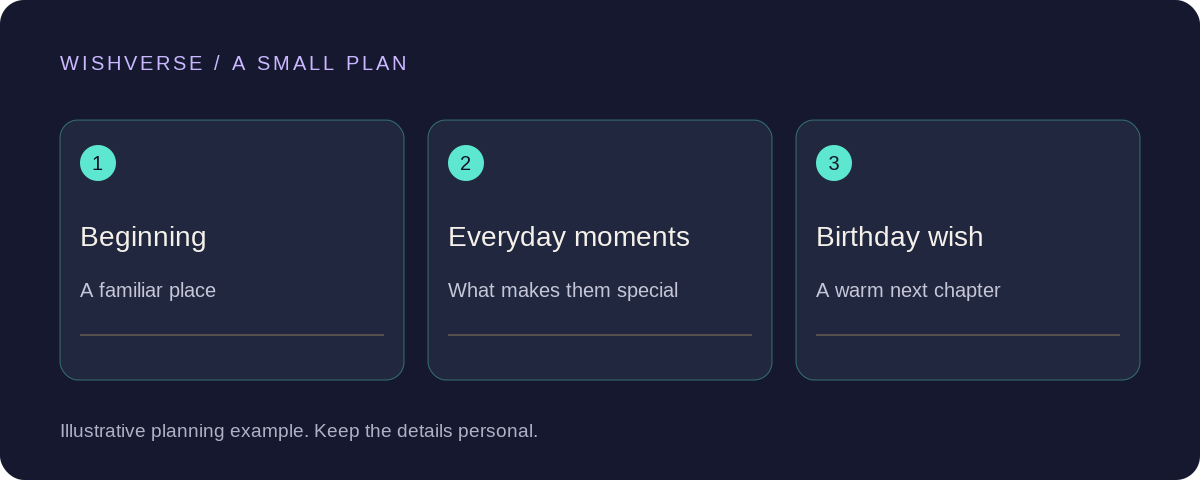
- Beginning: choose an image that is easy to enter. A familiar place, a portrait they like or an early shared moment can establish the mood without a long explanation.
- Middle: add variety. Show a small adventure, a routine or a moment that reveals a quality you admire. Avoid several pictures that all say the same thing.
- Ending: choose an image that supports your final birthday wish. It could be a recent moment, a place you want to return to or a picture of something they enjoy.
Chronological order is useful when change is the story, such as a year in a new city. For a story about friendship or a family routine, order by feeling instead. The reader should not need to solve a timeline to understand why the photographs matter.
A worked five-picture story
| Position | Picture | Caption direction |
|---|---|---|
| 1. A familiar beginning | The café where you often meet. | “Most of our good plans start with us saying we will only stay for one drink.” |
| 2. A small adventure | A rainy walk with mismatched umbrellas. | “The forecast was correct. Our confidence was not. I would still do it again.” |
| 3. An ordinary moment | A board game on the kitchen table. | “Not every good evening needs a destination. Sometimes it just needs your terrible victory speech.” |
| 4. Something you admire | A picture from a shared volunteer day. | “I love the way you make room for people who are new to a group.” |
| 5. A birthday ending | A recent comfortable portrait. | “Here is to more ordinary afternoons that turn into stories. Happy birthday, my friend.” |
These are fictional captions, not claims about real people. Replace every place, habit and memory with your own. If you cannot explain why a picture belongs in one sentence, it may be a spare rather than part of the story. Keep spares for another occasion instead of making the birthday collection longer by default.
Three caption patterns you can reuse
A memory plus its meaning
Try “The evening we missed the bus and walked home. I remember the conversation more than the delay.” The first sentence places the memory; the second explains why it stayed. Do not add a lesson if the memory is meaningful simply because you enjoyed being together.
A detail plus a quality
Try “You made sure everybody had a seat before sitting down yourself. That is a very small picture of a very familiar kindness.” This works when the image shows a quality you already know, but avoid assigning feelings to people in the photograph that you have not asked about.
A memory plus a gentle wish
Try “Our slow walk by the water. I hope this year gives you more afternoons with nowhere urgent to be.” Connect the wish to something the recipient enjoys rather than a plan they now have to agree to. A birthday wish can leave the future open.
Edit the sequence before adding decoration
- The opening image makes sense without several paragraphs of background.
- The middle includes different kinds of moments, not just five versions of the same pose.
- Each caption adds information or feeling instead of describing only what is visible.
- The final message addresses the recipient directly and includes a clear birthday wish.
- The story respects everybody pictured and keeps sensitive details private.
Read the captions without looking at the pictures, then view the pictures without reading. If either version feels confusing, simplify the sequence. You can remove a picture, shorten a caption or move a practical explanation into the main birthday message. Good editing often means making the collection easier to receive.
Put the story into a birthday surprise
In WishVerse, the Photos step lets you upload optional images, change their order and add captions and focal points. You can include up to ten photos, though this five-picture structure does not require that many. Check each crop in the preview so the sequence still works on a phone.
Keep the main birthday message separate from the captions. Captions can carry individual memories; the closing note can say what they add up to. If you need words for that ending, use the birthday-message writing guide. For the complete setup and link-delivery process, follow how to create a virtual birthday surprise.
Keep reading
Related articles
- Personalization guides
How to Choose Photos for a Birthday Surprise
Select birthday photos with meaning, comfortable sharing and clear crops. Use a practical shortlist, an example selection table and a final review checklist.
· 5 min read
- Birthday-message inspiration
What to Write in a Birthday Message When You Feel Stuck
Use a simple birthday-message formula, examples for different relationships and before-and-after edits to write something personal without forcing the words.
· 6 min read
- Birthday-surprise ideas
How to Create a Virtual Birthday Surprise, Step by Step
Build a virtual birthday surprise with a personal message, optional photos and a clear delivery plan. Follow the WishVerse workflow and a practical recipient checklist.
· 5 min read